
The mistake? You’re tracking sign-ups, not real engagement. Loyalty program software shows what’s broken, and what’s costing you money.
Continue reading
The mistake? You’re tracking sign-ups, not real engagement. Loyalty program software shows what’s broken, and what’s costing you money.
Continue reading
Uncover the keys to successful loyalty program management with our guide. Strengthen customer loyalty and increase sales like never before!
Continue reading
Are loyalty programs worth investing in for businesses? This article gives you everything you need to know and more!
Continue reading
Loyalty program software is a tool that helps businesses create and manage customer loyalty programs. These programs aim to boost customer loyalty, increase lifetime value, improve retention, and encourage engagement.
The software also tracks key customer interactions, such as their favorite purchase times, buying frequency, and preferred products. By understanding these behaviors, businesses can optimize their loyalty programs to work more effectively.
Many businesses integrate their loyalty programs with other systems like e-commerce platforms, POS systems, CRMs, and mobile apps, all managed through the loyalty software. This makes it easier to track and reward customer activity across different channels.
Loyalty program software also often includes gamification features to make programs more engaging. For example, businesses can offer incentives like lucky draws, quizzes, or daily check-ins to keep customers involved and coming back.
By using loyalty program software, businesses can not only increase customer retention and short-term sales but also build stronger, long-term brand loyalty. It’s a powerful way to encourage repeat business and create more meaningful connections with customers.
Before we get on with the best loyalty program software, we have to preface that this list is mainly focused on software that specializes and is designed for customer loyalty.
This means that the software in this list has to provide features and modules directly linked to increasing customer loyalty, improving customer lifetime value (CLV), encouraging referrals, etc.
As a result, CRM and data-collection software (like Salesforce or Hubspot) are out of the picture.
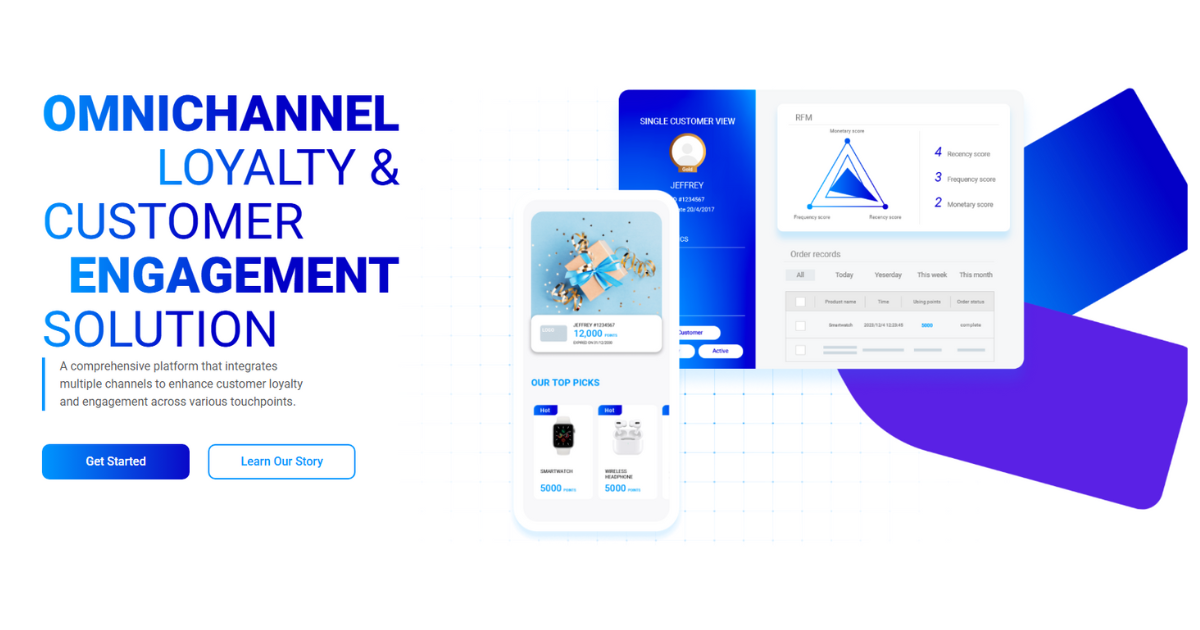
KlikNGo, developed by PRIZM Group, is our user-friendly loyalty program software that is ideal for small- to medium-sized businesses.
Unlike other more complex solutions, KlikNGo prioritizes simplicity and accessibility while offering powerful features. Our software includes point-based rewards, tiered systems, stamps, attendance tracking, and gamification to boost customer engagement.
A standout feature of KlikNGo is our omnichannel approach, allowing customers to earn and redeem rewards both online and in-store. We also offer robust marketing automation tools like SMS, social media campaigns, and chatbot integrations, enabling you to stay connected with customers through personalized communication.
KlikNGo also excels in integration flexibility, connecting seamlessly with various software and hardware, from e-commerce platforms to physical devices like kiosks and QR code scanners.
Not to mention, our software was coded from the ground up, which means we can integrate with virtually any type of specialty software, like inventory management software, etc.
This makes it adaptable to many business types, whether retail, hospitality, or services!
With pricing starting at around $1,020 per month, we believe we offer excellent value for businesses wanting a comprehensive loyalty program without the hefty cost of enterprise-level solutions.
Our ease of use, advanced features, and affordability make it a top choice for businesses aiming to strengthen customer loyalty.
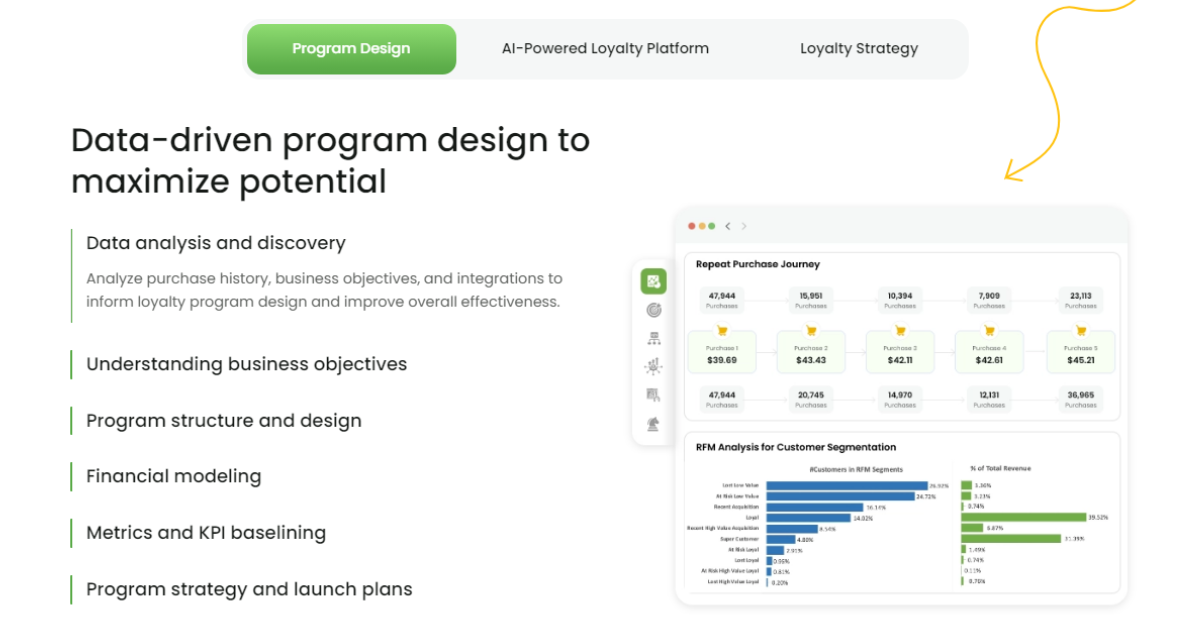
Zinrelo is one of the biggest loyalty software providers, providing enterprise-level loyalty software to over 2,000 clients worldwide.
This platform stands out for having the most tech features, notably robust integration options with other types of software, like marketing automation, CRM, payment services, and eCommerce.
For organizations that need a tech-forward, scalable loyalty solution, Zinrelo offers a comprehensive platform that integrates deeply into existing business ecosystems.
However, the complexity and high cost might be more than what smaller companies require at the outset.
To give you a perspective, we couldn’t find pricing on their website at the time of writing this article. However, we did manage to find their Capterra listing that mentions prices starting from $10,000.
If you’re interested in a more detailed look, check out our article, KlikNGo vs Zinrelo to find out more!
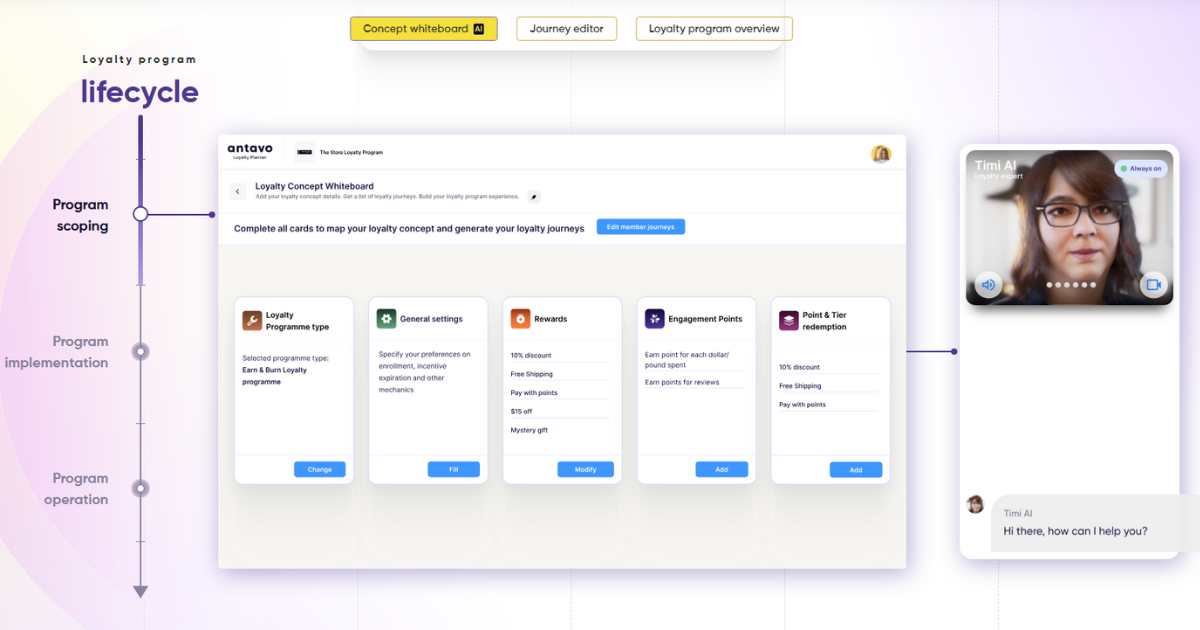
Anvato, founded in 2012, is a powerful loyalty technology provider that excels in offering a wide variety of loyalty program solutions for larger enterprises.
Primarily focused on retail, Anvato also serves industries like food and beverage, hospitality, and financial services.
The platform provides businesses with multiple loyalty program types, including tiered, coalition, hybrid, and subscription programs, making it a top choice for companies looking for flexibility and diverse options.
One of the prime reasons why they’re revered in this industry is because of their advanced gamification tools and features, like treasure hunts and interactive quizzes.
This approach is exactly what brands are looking for – as traditional points and tiered systems aren’t enough for customers to stay engaged.
Not to mention, they also prize wheels and receipt-scanning features to add another layer of omnichannel engagement (online and offline engagement).
Anvato has many robust loyalty program types, features, and pretty much everything you can think of.
Check out our KlikNGo vs Anvato article to find out more!
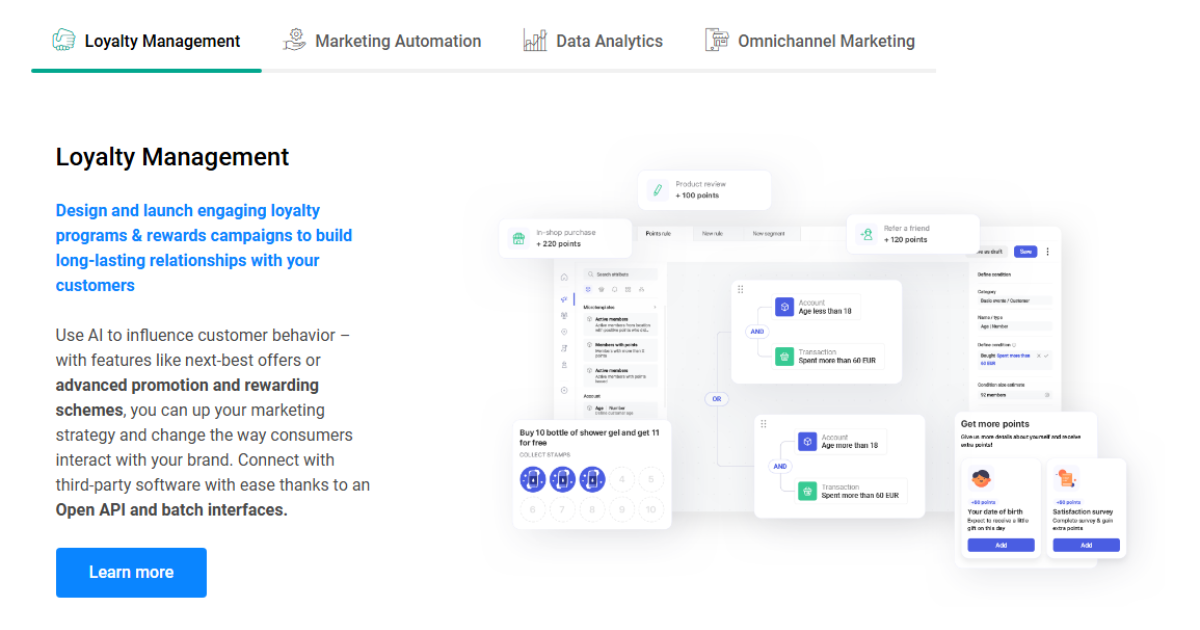
Comarch Loyalty is a high-end loyalty management software designed for large enterprises. Founded in 1991, Comarch has established itself as a leader in enterprise software, and its loyalty platform reflects this expertise.
The software offers an extensive range of features focused on enhancing customer retention and driving ROI, making it particularly suited for large-scale businesses.
A key strength of Comarch Loyalty is its omnichannel capabilities. It allows businesses to engage customers across multiple touchpoints—whether online, via mobile apps, in-store, or through call centers.
This integrated approach ensures a seamless customer journey, regardless of the channel. The platform’s high-tech marketing automation features enable personalized offers, recommendations, and campaigns across these various channels, creating highly targeted customer experiences.
Comarch Loyalty also has great integration options with its ability to integrate with various systems like POS, CRMs, payment solutions, and marketing platforms.
Overall, Comarch Loyalty is an excellent choice for big corporations that need a powerful, all-in-one solution to manage complex loyalty programs across multiple channels.
Its advanced features and scalability make it a top option for enterprises with the resources to fully leverage its capabilities.
Take a look at KlikNGo vs Comarch to learn more!
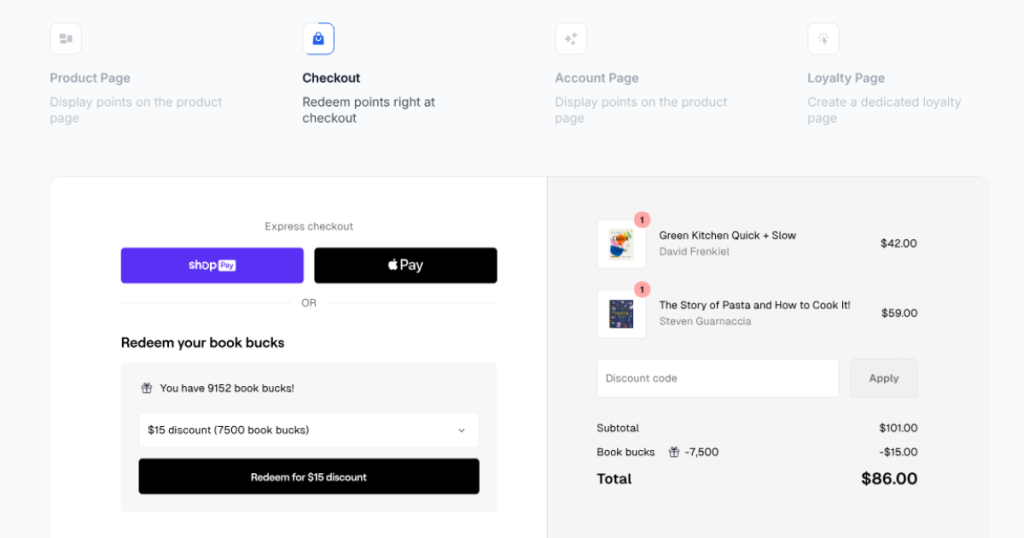
Smile.io is a user-friendly loyalty program software designed to boost customer retention through easy-to-manage rewards systems. They don’t have a lot of loyalty program types (mainly just points, VIPs, and referrals), but they do them considerably well.
Focused on simplicity and efficiency, it enables businesses of all sizes to create personalized, engaging loyalty experiences without needing technical expertise.
Since Smile’s software foundation is open-sourced, you can find many solutions online and solve issues yourself.
It also integrates seamlessly with e-commerce platforms like Shopify and BigCommerce, making it easy to add loyalty features to your website or e-commerce store.
Smile.io offers automation tools to manage customer rewards, including automated emails and notifications, along with customer segmentation for targeted campaigns. Smile’s ease of use and strong customer support make it a great choice for businesses with limited technical resources.
While Smile.io lacks certain advanced customization like a gamification engine of more complex platforms, it excels as a straightforward, effective loyalty solution for businesses that want to set up a rewards system quickly.
However, it’s worth mentioning that they only support e-commerce loyalty at the moment, meaning no omnichannel or physical integration.
Here’s KlikNGo vs Smile if you want to learn more!
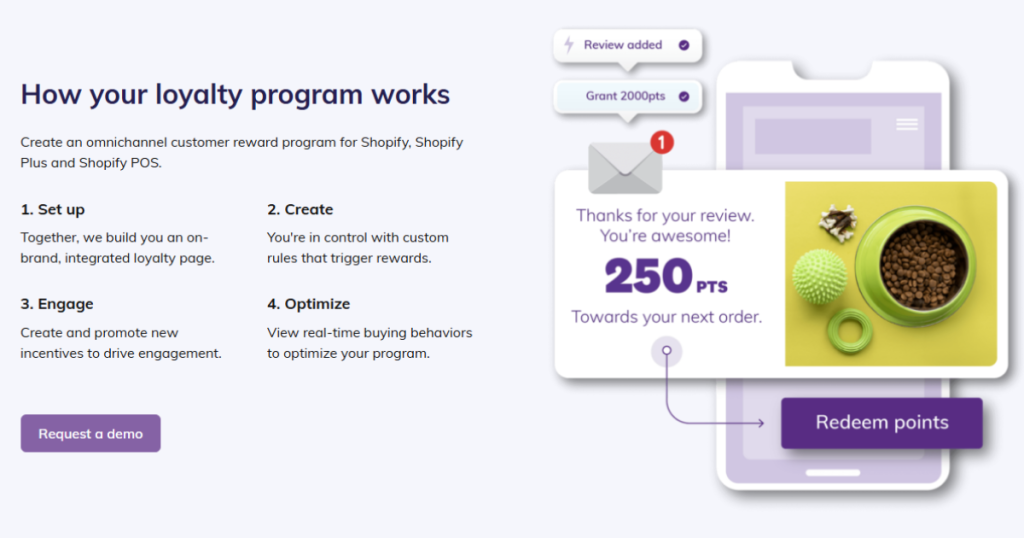
LoyaltyLion is a cloud-based loyalty program designed specifically for eCommerce businesses. It primarily focuses on point-based rewards, where customers earn points for actions like purchases and referrals. These points can be redeemed for discounts and other perks.
LoyaltyLion integrates directly with popular eCommerce platforms such as Shopify and WooCommerce, making it a strong player in the eCommerce loyalty space. The platform also connects with widely used tools like HubSpot, MailChimp, and Zendesk to enhance customer engagement.
The platform also offers tiered loyalty programs based on customer spending, where customers can access exclusive rewards. This system allows businesses to create rules and rewards for different segments, such as high spenders or top referrers.
While LoyaltyLion provides some omnichannel integration through tools like ConnectPOS, its omnichannel capabilities are limited compared to other solutions.
The platform’s customization options are also somewhat restricted, offering only basic design tweaks, which may hinder businesses looking for a highly personalized experience.
Overall, LoyaltyLion is a solid choice for businesses seeking an easy-to-implement, affordable, point-based loyalty program for their online stores.
Take a look at KlikNGo vs LoyaltyLion for a more detailed look!
When looking for loyalty program software, there are a few key features to keep in mind to make sure it fits your business needs.

A points-based loyalty program is a type of loyalty program where customers earn points for making purchases or completing missions, which they can later redeem for rewards.
This approach is also a form of gamification, as it taps into the enjoyment customers get from earning and redeeming points.
Research in behavioral economics and consumer behavior has shown that this system effectively motivates and engages customers.
The business decides how customers earn points and what they’re worth. Usually, points are tied to how much money a customer spends.
There are two main things to keep in mind:
1. How much do customers need to spend to earn a certain number of points?
2. What the points are worth when redeemed, like the value of the rewards?
For example, a business might give 1 point for every dollar spent, but the points could be worth less when redeemed — like 1 point is worth only $0.50. Points can also be used for other rewards, like services or extra products.
Using the same example, let’s say a customer earns 1 point for every dollar spent. If they want to redeem a reward that costs 150 points, they need to spend $150 to get enough points.
If you’re wondering, the most common industries that use point-based loyalty programs are the retail, service, and FMCG industries!
Yes, points-based loyalty programs are highly flexible and can be combined with other types of loyalty strategies to create a customized program that covers multiple aspects of customer loyalty strategies.
Imagine you run a hair salon with a tiered loyalty program where members receive increasing benefits based on their tier.
If you want to introduce points into the mix, you can reward your most loyal customers in the highest tiers with more points.
This can also encourage customers to level up to higher tiers by earning more points, creating a system where both points and tiers work together to boost overall engagement and revenue.
Points-based programs are also effective for targeting specific customer segments, especially those who are inactive or have lower purchasing frequency.
You can do this by offering double points or other special rewards and motivating these customers to engage more with your brand.
Another advantage of points-based programs is their ability to be dynamically adjusted.
You can tweak the value of rewards, the amount customers need to spend to earn points, and the worth of points when redeeming.
This flexibility allows you to fine-tune your program’s effectiveness based on performance metrics, without making major changes to other parts of your program, like tiered benefits or referral rules.
As mentioned earlier, points-based programs are highly flexible, allowing you to adjust point values, redemption rates, and more.
You can also combine them with other loyalty strategies, such as tiered programs, referral rewards (where customers earn points for referrals), or attendance programs (where points are earned for regular visits)
Additionally, points programs enable you to target specific customer segments effectively, encouraging more brand engagement or higher spending through strategies like double point promotion campaigns.
One of the best things about points-based programs is the instant gratification they provide.
When customers earn points, they feel a quick sense of satisfaction, which helps create a positive connection between buying from your brand and feeling good.
And it’s not just about earning points—redeeming them for rewards brings an extra boost of happiness.
Other loyalty programs, like tiered systems, don’t offer that same quick reward, which is why points-based programs are so great at tapping into this instant feel-good factor.
Over the years, we’ve worked with many clients, and from our experience, points-based programs are one of the most effective ways to boost customer spending and increase lifetime value.
Points work so well because they encourage customers to spend more with each purchase (thanks to that instant gratification we mentioned earlier). The more they spend, the more they’re rewarded.
When you pair points with personalized rewards that appeal to customers, it’s a powerful combination for not only increasing spending but also building long-term loyalty.
You can even take it a step further by offering secondary rewards, like advancing to higher tiers or earning stamps based on how much they spend.
Points are some of the best ways to track your customer’s behavior and create individual customer profiles. Here are some of the cool things businesses can track via points:
Among all loyalty program types, points definitely give you the most data on your customers’ or members’ spending habits.
We highly recommend a point-based program when you’re first starting your loyalty program – as it can give you a head start on getting to know your customers!
KlikNGo worked with Nestlé to create a loyalty program that combines points with other rewarding features.
This project stands out because we helped Nestlé partner with companies across different industries, allowing customers to redeem rewards not just for Nestlé products, but for things like amusement park tickets, hotel stays, gift cards, and more.
Nestlé also needed a way to accurately track points earned from both purchases and other activities, so we built a centralized rewards portal.
This made it easy for them to track customer behavior online and offline, even integrating with tools like barcode scanners for a seamless, omnichannel experience.
Results: Increased Loyalty Program Awareness & 100% Reward, and Redemption Tracking Accuracy.
Häagen-Dazs Hong Kong was looking for a user-friendly combination of a points program alongside a stamped one.
So our team made one that is easy for users to join and made it even easier to redeem rewards like free ice cream or discounts.
Other than that we also helped with voucher marketing (customers can redeem points or vouchers online or offline) as well as helped them with a gifting and delivery management platform.
Pacific Coffee wanted a loyalty program that combined points, loyalty cards, and e-wallet integration.
They set up the program so that points earned from purchases would have flexible expiry dates, encouraging customers to use them sooner.
Customers could also add money to their cards to earn even more points, which encourages them to keep adding funds. On top of that, they launched a coffee subscription service, where customers pay a monthly fee for a set number of cups of coffee.
Subscribers can redeem 20 points for a $1 rebate, making it a special perk for them. This not only boosts the value of points but also adds a unique benefit for those in the subscription program.
Results: Revenue increased across all outlets thanks to the subscription plans and loyalty program. By tracking points and customer behavior, they were also able to improve their operational management.
First things first, you have to understand that a points reward is a type of rebate. Use this as a rule of thumb when you’re starting your own points reward program.
In most industries, a common rate is a 1% rebate. This means a percentage of the total transaction value is converted into points. To give you a point of reference, here is the list of industries and their point rebate standards:
Depending on your profit margin and strategy, a good practice is to offer a slightly higher rebate rate than your competitors.
This is a good first start if you’re just getting started in your loyalty strategy because you’re not necessarily reducing your profits, but more of allocating a portion of it to enhance customer satisfaction.
So, why higher rebates? When you offer a higher rebate rate, you can stand out from your competitors, and encourage customers to return for more purchases or redemptions.
Think about it, as long as customers haven’t redeemed their points, it costs you nothing in terms of cash or physical rewards!
We would highly recommend you avoid offering a rebate rate that is lower than the industry standard, as it can reduce your competitive edge and hurt your branding.
After that comes encouraging customers to sign up and become members. In this process, you’ll want to collect some basic information like:
You could ask for more, but in our experience, this is what you’ll need to get started. Many businesses make the mistake of asking for way too much, way too soon – as it can deter customers from signing up.
You can always gather more information and build each customer’s persona throughout their journey.
After that, you’ll want to set up your point structure according to the industry standard rate from Step 1. Remember, following your industry standard should be fine.
Note that many businesses, especially in the fashion industry, set a minimum purchase requirement for free membership.
Some even charge a yearly membership fee in exchange for a membership card or exclusive physical gifts. You might want to consider these for your points loyalty program.
Since there are many requirements and criteria for a points program, doing it manually will take up valuable time and resources. As a result, you’re going to need the right tools and software for the job.
At this point, we assume that you’ve done some research or gained basic knowledge about loyalty reward systems. Many people think you need to create your own system from scratch to run a rewards program.
In fact, many SaaS solutions give you access to everything you need.
For example, our solution – KlikNGo gives you access to a wide range of software, alongside a custom direction plan through our free consultation to give you the best chance of succeeding.

The next step is to create marketing materials that highlight your program and use them both online and offline. Make sure to incorporate these into your online marketing strategy as well.
After all, you need to let people know about the program for it to work, right? One of the best places to do this is during the checkout process, whether that’s online or in-store.
You can also consider offering instant rebates to encourage customers to sign up right away, making the process even easier.
Another important factor that many business owners overlook is staff training on the new system.
It’s not just the backend (like the system setup, requirements, and reward structure)—it’s also about how your team interacts with customers and handles the program in practice.
To be fully prepared, your staff should have a solid understanding of the program. No, it’s not just about knowing how rewards are earned and redeemed; it’s also about being able to explain why the loyalty program is valuable and important to your customers.
In our experience, the way your staff communicates and implements the program can make all the difference between success and failure.
When it comes to promoting your program, consider offering extra benefits, points, or gifts for new sign-ups for a limited. This creates a sense of excitement and awareness among your customers.
The flexibility of your system is key here. A good, stable, and comprehensive system should be able to support multiple reward schemes to cater to different situations. It’s important to remember that a reward program is a long-term investment.
So, choose a solution that allows you to explore different reward options and scenarios as your business grows. Points are just the beginning—you’ll want to offer new rewards, tactics, and gamified features to keep customers engaged. Simply put, engaged customers typically spend more.
For online promotion, be sure to utilize social media and broadcasting (email, SMS, etc.)—how you promote it is up to you.
Offline promotions, on the other hand, could be dealt with by setting a weekly target for your staff to recruit new members or promote the program.
Take inspiration from techniques used by brands like Watsons, which always asks if customers have a membership or want to add on a product. Similar to how McDonald’s and Starbucks often ask if customers want to upsize their meals or drinks.
Remember, how your staff communicates with customers is crucial. The moments when they interact with customers are the best opportunities to introduce new products, promotions, and your brand’s culture.
Definitely! Businesses should consider using a points system in their loyalty programs.
It’s simple, yet one of the most effective and widely used options. When people think of loyalty programs, they often think of earning points.
Plus, points give customers instant rewards credited into their account, making them feel good about their purchases and creating a positive connection with your brand.
As we mentioned earlier, points also help you learn a lot about your customers, like what rewards they like and how they prefer to earn and redeem them.
Point-based programs are especially valuable in industries like fuel, utilities, or groceries, where the products are often similar across different brands.
In these cases, a loyalty program—especially one based on points—can be a great way to stand out, since these businesses often focus on high volume rather than repeat purchases.
It’s no wonder that big brands like ExxonMobil, Starbucks, and Sephora all rely on points-based loyalty programs.

Looking for an overview of tiered loyalty programs? Click to check out what they are, look at successful case studies, and much more!
Continue reading
A B2B loyalty program is a marketing strategy made to encourage repeat business volume and frequency and strengthen relationships between companies, while also encouraging brand stickiness and stability. Like all loyalty programs, B2B loyalty programs are about customer trust and benefits.
Traditionally, loyalty programs weren’t common for B2B businesses, mainly because of the extra time and effort required to manage them.
Many B2B businesses opt to experiment with a loyalty program, once they have the resources to launch them.
The good thing about B2B programs is that it indirectly tells clients that your business is doing well and that they can trust you to be a long-term partner, and encourage collaboration. In short, it helps with your overall corporate and brand image!
Besides big corporate entities, are loyalty programs practical for other types of businesses? Well there is, and you might not expect to see this coming up.
Famous international direct sales companies (aka MLM companies) like Amway, Coway, Herbalife, USANA, etc., use a combination of different B2B loyalty program types with features like commission, referral, tier, team incentives, etc.
If you’re unfamiliar, MLM companies recruit users to become their agents/resellers, or even distributors. Most of the time, these resellers are also product users and earn a commission on revenue or agent recruited. Hence the need for different types of features in their loyalty programs.
Many of these MLM companies have intricate structures, and most of them even have a dedicated app for agents/partners to download to keep track of important data like referrals, commissions earned, sales tiers, and even company news and product information.
Yes – not everyone is a big corporation or MLM business owner. So let us answer the question, how can normal businesses go about B2B loyalty programs?
Depending on your business, many B2B businesses can benefit from subscription-based or cash-back programs. Let’s take office stationery or an HVAC company for example.
These companies can charge a monthly subscription or maybe a yearly retainer for clients to have a long-term commitment, making sure that they have good cash flow and continuous business.
Of course, make it worth your client’s while. Make them want to subscribe to your loyalty program, by giving perks like free maintenance, free upgrades, early access to new products, or simply giving things like personalized consultation and priority support can also do wonders.
If you’re interested, here’s a great case study that we’ve done for one of our B2B clients:
Other than rewarding clients for their loyalty and encouraging long-term business, other objectives might improve customer experience.
For example, having a loyalty app can help your business stand out, especially if you sell products that are similar to what other companies offer. Commodity goods are things like basic supplies or raw materials that are pretty much the same no matter who sells them.
If the price and quality are the same, businesses will stick with the one that makes buying easier and better.
In the B2B space, this might mean making it super simple for customers to buy things—like letting them place an order with just one click and getting it delivered fast.
A loyalty app also gives customers a way to share feedback or get in touch with you. That’s why loyalty programs are so important for businesses like oil & gas companies (millions are invested every year)—they help them stand out from the competition.
Loyalty programs can also help increase how much and how often customers buy from you, this is what we call customer lifetime value. This could mean getting them to place larger orders or buy more often over time.
Most importantly, a B2B loyalty program shows that you’re a trustworthy business that offers value over the long term—not just a name on the quotation.
Contrary to popular belief, the metrics used to measure B2B loyalty program success are very different from B2C ones. Unlike B2C, we don’t typically measure metrics like customer engagement.
In B2B, the most important metric to measure is how smooth and quick the operational processes are. If clients have deadlines to meet, they won’t have time to stick around and engage in your loyalty program.
Here are the different metrics that B2B businesses use to measure their loyalty program success:
The rewards are what make your B2B loyalty program attractive to clients. Usually, to determine the best rewards, you should look at what’s working for other companies in your industry.
Big players often have dedicated teams that understand customer behavior and industry trends, so it’s a good idea to observe their strategies.
Here are examples of what works for different industries:
The goal is to offer rewards that make your clients feel valued and incentivize them to keep coming back.
When you’re ready to launch, choosing the right tools and systems is key. As we’ve mentioned before in the B2B space, customer experience and smooth operational processes are the most important factors.
Ideally, you’ll want your B2B loyalty program to reflect that, and include intuitive things to make everything flow smoothly – like having an automatic invoice generator like we talked about before.
A closed-loop system works best for B2B businesses because it integrates your backend operations while providing a seamless experience for your partners.
Tracking data efficiently is probably the most important thing you can do in a loyalty program. If you’ve been reading the article thoroughly until now, you should already know what type of data is important to track by now.
Remember, client data is important in B2B (not really engagement metrics). As a result, we’d highly recommend you get a CRM system if you don’t have one in place already.
A CRM, alongside other data collection technology, helps you keep all data in one place – keeping track of every single client touchpoint (like contacting customer service, upsells, etc.).
Having it all in your CRM, instead of it being fragmented in multiple databases makes sure that you have a ‘single customer view’, helping to build a persona of your clients.
This allows you to personalize your strategy for each client, helping you retain and reward them.
A successful B2B loyalty program is built on a solid strategy, not just the latest technology. While advanced tools and platforms are important, they won’t help you if you don’t have a clear strategy in place.
Think about your short-term goals (like upselling or decreasing customer service load) and also long-term objectives (like strengthening partnerships).
Invest time in understanding your client’s needs and behaviors, and then use the right technology to support that strategy.
A loyalty program is a long-term investment, and without a clear roadmap, even the best tools won’t deliver the results you need.
Once your program is up and running, make sure you continuously optimize it based on the data you collect.
Look at which clients are the most satisfied, upsell potential, and where you can improve.
With the right reporting tools, you’ll be able to track all of this and adjust your approach as needed, creating a program that evolves and delivers ongoing value.
Feedback is probably the most important thing in this category, as this usually shows what your clients are feeling. Other than a feedback form, you can also use NPS (Net Promoter Score) as a metric to track satisfaction.
The whole point of data is so you can optimize and improve your program over time. This makes sure that you can stay competitive in the market and don’t give clients a reason to switch to competitors.
If you’ve made it this far, we’re guessing you’re considering a loyalty program for your B2B business.
Whether you’re just getting started with CRM, or you need expert advice on loyalty programs, KlikNGo can help at any stage of your digital journey.
Check out our loyalty program product page, or if you’re feeling bold, reach out for a free consultation! We’re here to help.

Finally ready to create your own loyalty program? Check out our article going through how you can make your own loyalty program!
Continue reading
You might’ve heard of omnichannel experience integration, but how much will it cost? Click here to learn more!
Continue reading
What is omnichannel experience? The future of business is here. Learn how to deliver consistent, engaging experiences across all touchpoints.
Continue reading